Looking for Business Financing?
Apply now for flexible business financing. Biz2Credit offers term loans, revenue-based financing, lines of credit, and commercial real estate loans to qualified businesses.
Set up a Biz2Credit account and apply for business financing.
Miami-Dade County is not simply recovering in the years following COVID. It is expanding. A special spotlight on South Florida from Biz2Credit’s forthcoming Q2 Quarterly Credit Monitor Report confirms what the local economic data has already signaled: South Florida's small businesses are growing revenue, taking on more capital, and posting stronger margins than their counterparts across the rest of Florida.
Revenue and Profitability Trends
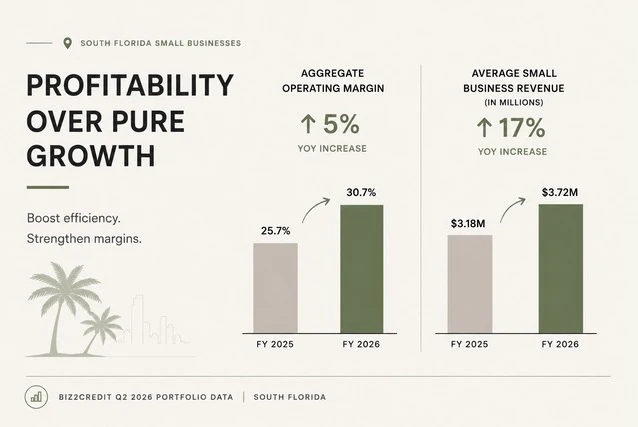
The numbers are direct. In our Q2 2026 portfolio, the average small business in Miami and South Florida generated $3.72 million in annual revenue, up 17% from the same period a year ago. Total dollars funded to South Florida small businesses nearly doubled, up 79% from Q2 2025 to Q2 2026.
Profitability moved in the same direction. Aggregate operating margin for Miami and South Florida small businesses reached 30.7% in Q2 2026, up from 25.7% a year earlier. That is six percentage points higher than the aggregate margin posted by small businesses in the rest of Florida over the same period. South Florida businesses are not just growing. They are growing more profitably than the state average.
This continues with the broader signal trend established in Biz2Credit's Q1 2026 national Credit Monitor Report: lenders have grown more selective, and the small businesses breaking through are the ones proving they can convert revenue into durable margin, not just top-line growth. South Florida's small business sector is doing exactly that, and doing it at a greater rate than the rest of the state.
Balancing High Leverage and Cash Flow Metrics
The data also surfaces a tension operators and lenders should watch. South Florida businesses are carrying more leverage than their statewide counterparts. The aggregate leverage ratio for the region climbed to 8.4% in Q2 2026, nearly triple the 3.0% ratio posted by the rest of Florida. Debt service coverage, while still healthy, is tighter in South Florida: a median DSCR of 1.27, compared to 1.71 statewide.
The average South Florida borrower also took on new debt more frequently than the state average over the trailing three months.
But, none of these figures signal distress. A DSCR above 1.0 means a business generates more operating income than it owes in debt payments each period, and South Florida's median sits comfortably above that line. But the region is financing its growth more aggressively than the rest of the state, and that growth is outpacing a separate signal in the data: the average South Florida borrower's bank transaction-based revenue measure actually declined year-over-year, even as top-line annual revenue rose. That divergence is worth watching. It may reflect a shift toward higher-margin, lower-transaction volume service businesses, consistent with local job growth in professional services and healthcare. It may also reflect early strain in cash flow timing that has not yet reached the margin numbers.
The Broader Economic Backdrop
Miami-Dade's broader economic backdrop explains why lenders are willing to extend that capital. The county is home to more than 173,000 businesses generating over $251 billion in annual revenue, according to the Miami-Dade Beacon Council. Unemployment sits between 2.4% and 2.6%, more than a full point below the statewide rate. Professional and business services added 6,100 net jobs over the past year; education and health services added another 4,000. This is a market where capital demand is being pulled forward by real job and revenue growth, faster than the rest of the state can match.
Local and Federal Support Ecosystems
Local infrastructure is expanding to meet this demand. The Miami-Dade Beacon Council recently assumed stewardship of Strive305, the county's small business growth initiative. The program connects scaling entrepreneurs with capital providers, technical assistance, and business resources. Local support systems grow increasingly critical as these businesses evolve. The initiative reflects the Beacon Council's broader strategy to strengthen the regional ecosystem, ensuring small businesses can access financing alongside the talent and partnerships required for operational stability.
In Washington, the Made in America Manufacturing Finance Act, which would double SBA 7(a) and 504 loan limits for small manufacturers to $10 million, passed the House unanimously in December 2025 and now awaits Senate action.
South Florida's small businesses are proving they can grow. The next test is whether they can grow without over-leveraging the balance sheets that got them here.
— Rohit Arora, CEO and Co-founder, Biz2Credit
Latest News Articles

Q1 Quarterly SMB Credit Report: Why Stronger Small Businesses Are Breaking Through

House Introduces Small Business Tax Cut Bill