The Entrepreneur’s Guide to Business Loans for Food Delivery
The food delivery industry has evolved. What started as a restaurant only sector, has evolved into ghost kitchens and aggregated marketplaces. Irrespective of your business model, managing deliveries requires trained staff, investment in delivery fleet, and in the modern times, even software tech. Aspiring food delivery business owners, or small restaurant owners may prefer to take business loans for food delivery. With faster access to funds in hand, they can set up their delivery fleet, hire personnels, and streamline deliveries.
Making the digital transformation has become a necessity today for small restaurants where the primary competition is from large food delivery apps. As per statistics, Millennials and Gen Z order food from delivery apps at least once a week, whereas the figures drop to 21.5% and 10% for Gen X and baby boomers respectively.
Not just to compete with digital competition, business loans for food delivery can be used to set up your ghost kitchen as well or expand to new regions.
Who Can Apply For Business Loans for Food Delivery
How to Use Business Loans for Food Delivery
01 Expand to New Regions/Setting up New Kitchens
Business expansion can be costly, but with the rising commercial real estate costs, the expansion becomes time sensitive. Business loans for food delivery businesses can be used to purchase and set up commercial kitchens and restaurants at the right times when at the costs and interest rates match expectations.
02 Set Up Food Delivery Fleet
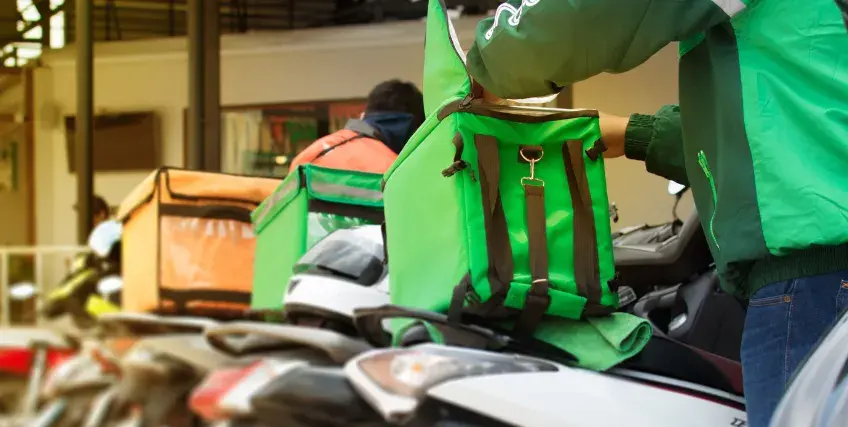
Two wheelers are the undoubtedly the most common type of delivery vehicles in the food industry. Commercial auto loans may help establish this fleet without majorly impacting your monthly cash flow.
03 Upgrading to EV Fleet
Reducing operational costs means higher profit margins. With the fuel costs rising, switching to EV can be a smart move.
04 Buying Kitchen Equipment
Commercial kitchen equipment like ovens, friers, grills, steamers, grinders, mixers, stoves, refrigerators, food counters, and more, can be expensive. Financing them through business loans for food delivery makes sense for startups.
05 Renovating Ghost Kitchens
Business financing can also be used for renovating ghost kitchens. Business owners can ensure their kitchen areas remain hygienic and meet food delivery compliance.
06 Integrating Software Tech
Managing food deliveries, especially at a growth phase, can be quite hectic. Food delivery software can streamline operations through ordering interfaces and delivery staff apps.
07 Launching Food Delivery Marketplaces
The food delivery marketplace business remains asset light. Entrepreneurs can scale without setting up their own restaurants and ghost kitchen spaces. However, such marketplaces require investment into food delivery ecosystems, which may include food ordering apps for customers, order management apps for restaurants & ghost kitchens, delivery staff apps, and admin dashboard for the marketplace owner. Business loans for food delivery apps can cover the development costs of such ecosystems.
08 Working Capital
Lastly, during turbulent times, short-term business loans and revolving line of credit can be used for managing expenses like payroll, utility bills, groceries, marketing costs, and repair work.
09 Buying a Franchise
With several popular food chains available in the US, entrepreneurs can take loans for food delivery brand as well. These loans will cover the entire franchise costs, training costs, and equipment costs. The franchise partner may also provide you industry insights and assistance to pick up pace and enter the market with full confidence.
Types of Business Loans for Food Delivery
Term Loans
These are traditional loans that come with a lumpsum amount at pre-decided interest rates. Several lenders provide these options to qualifying restaurant owners with a stable financial income and acceptable credit scores. Lenders may allow business owners to negotiate terms like loan amount, interest rates, loan tenures, and other repayment terms. Usually, monthly payments are easy to manage under term loans as owners can decide the loan tenure depending on their repayment capabilities. Term loans are also multi-purposes, and can be used to expand kitchens, set up delivery fleet, or buy kitchen equipment.
SBA Loans
The Small Business Administration supports enthusiastic small business owners by providing them financing options through non-profit community development lenders. While the lenders provide the funds, SBA partially guarantees the loan amount. Even under SBA, restaurant owners can opt for 504 or 7(a) loans:
SBA 504 loans: These loans can be used to set up new kitchens, enter new regions, or refinance selected debts. Max loan amount available is $5.5 million.
SBA 7(a) loans: These loans can be used to purchase franchise, commercial real estate, or bulk equipment. Owners can use these to manage working capital as well. Under 7(a) loans, the max loan amount available is $5 million.
Apart from these, the SBA offers microloans as well with a max loan amount of $50,000 with flexible usages.
Commercial Real Estate Loans
For expanding into new regions or making time sensitive investments where rates are expected to blow up because of inflation, commercial real estate loans can help. These business loans for food delivery businesses secure the principal amount with the purchased property. In case of a default, the lender may seize the property, whereas business assets and personal assets of the owner remain protected. Usually, these are long term loans, spanning the repayment over a large period to keep monthly payments low.
Note: Lenders may evaluate the direct coverage service ratio (DSCR) or the revenue generation potential of the property to process these loans.
Business Line of Credit
For continuous access to funds like a credit card, lines of credit are a reliable business loan option for food delivery. Be it renovation, commercial vehicle purchase, kitchen equipment purchase, software investments, groceries or even delivery staff salaries, business line of credit can be used flexibly to meet diverse expenses. As food delivery businesses repay the loans with monthly payments, they keep freeing up credit line and can borrow again.
Equipment Financing
We discussed above how expensive kitchen equipment can be. When expanding to multiple regions, the costs can surge. With equipment financing, these costs can be managed. Startup food delivery businesses can use equipment financing as food delivery startup loans to set up their commercial kitchens and start business operations. However, lenders may ask business owners to make an upfront downpayment to secure the loan.
Commercial Auto Loans
For building a fleet of two-wheelers, or investing in EVs, commercial auto loans are smart options. They can help you arrange delivery vehicles for the staff at convenient monthly payment. Lenders often offer competitive interest rates with these loans, so you can explore the loan market a bit more and select a lender that best matches your requirements. In these types of business loans for food delivery, the vehicle itself secures the loan.
Eligibility Criteria to Secure a Business Loan for Food Delivery
Different lenders follow their own eligibility criteria, but from a distance, it may look like this:
Credit Score
Usually, lenders prefer a credit score above 670, which falls under the ‘Good, Very Good, and Excellent’ credit ranges as explained by Experian.
Income Stability
Documents like bank statements, income tax returns, monthly sales records, and other financial statements may help you prove your income stability.
Debt to Income Ratio
The debt-to-income ratio helps lenders evaluate how do you manage your existing debts and if you can afford another one. Try refinancing or closing any previous business debts to improve your chances.
DSCR
In case of commercial real estate business loans for food delivery, lenders may evaluate the DSCR ratio or earning potential of your property. Generally, the idea prefers a DSCR above 1.25 but again, this can vary.
Business Plans
Food delivery business owners may use business plans to establish creditworthiness. Try presenting a solid business plan with a diverse revenue model and justifiable growth projections.
Downpayment
Certain loans require borrowers to make some downpayments.
Guarantor or Co-Signee
Try reducing the overall risk of default by having a guarantor or co-signee. With shared risks, lenders may say your loan application positively.
Final Thoughts
Getting a business loan for food delivery can make it much easier for small restaurants and new food ventures to keep up with today’s changing industry. With quick access to funds, they can build their delivery team, invest in the right tools, and even explore new models like ghost kitchens. Whether you want to compete with big delivery apps or expand to new areas, the right financial support can help you grow faster and run your operations smoothly.
Trusted by Thousands of Small Business Owners in America.**
Simply because we get what you go through to build a business you believe in.
**Disclaimer: All stories are real, as told by real business owners. Customers do not receive monetary compensation for telling their stories.
From One Entrepreneur to Another: We Get You
We understand what's behind building a business you believe in.
All stories are real, as told by real business owners. Customers do not receive monetary compensation for telling their stories.


Loan for Food Delivery Brand Articles

Loan for Food Delivery Brand: Financing Solutions to Scale Your Business
The food delivery industry in the United States is seeing continuous growth these days..

Food Delivery Startup Loan: Funding Options for New Food Delivery Businesses
No wonder the idea of launching a food delivery business in the United States...
Food Delivery Business Loan: Financing Options to Scale Your Delivery Service
The food delivery space is one of the most competitive industries that is continuing...
FAQs about Business Loan for Food Delivery
1. Why may I want to take a business loan for my food delivery business?
Taking a business loan for food delivery model can help you set up a delivery fleet, renovate kitchen equipment, set up ghost kitchen, or even increase reach via marketing.
2. What is the interest rate on food delivery business loans?
There’s no fixed interest rate. It changes frequently based on market conditions and also depends on your credit profile. To find out the rate applicable to you, consult a loan expert.
3. What documents I need for a business loan for food delivery?
Lenders may ask business ownership proof, identity proof, bank statements, tax returns, and more.
4. Which is the best loan option to launch more food delivery stores?
It truly depends on your requirements and loan repayment capabilities. Some options include term loans, SBA loans, and commercial real estate loans.
5. Can I get insurance for my business loan?
Several lenders provide the option to ensure your business loan. This will add another safety layer on your food delivery business loan.
Frequent searches leading to this page
Term Loans are made by Itria Ventures LLC or Cross River Bank, Member FDIC. This is not a deposit product. California residents: Itria Ventures LLC is licensed by the Department of Financial Protection and Innovation. Loans are made or arranged pursuant to California Financing Law License # 60DBO-35839